
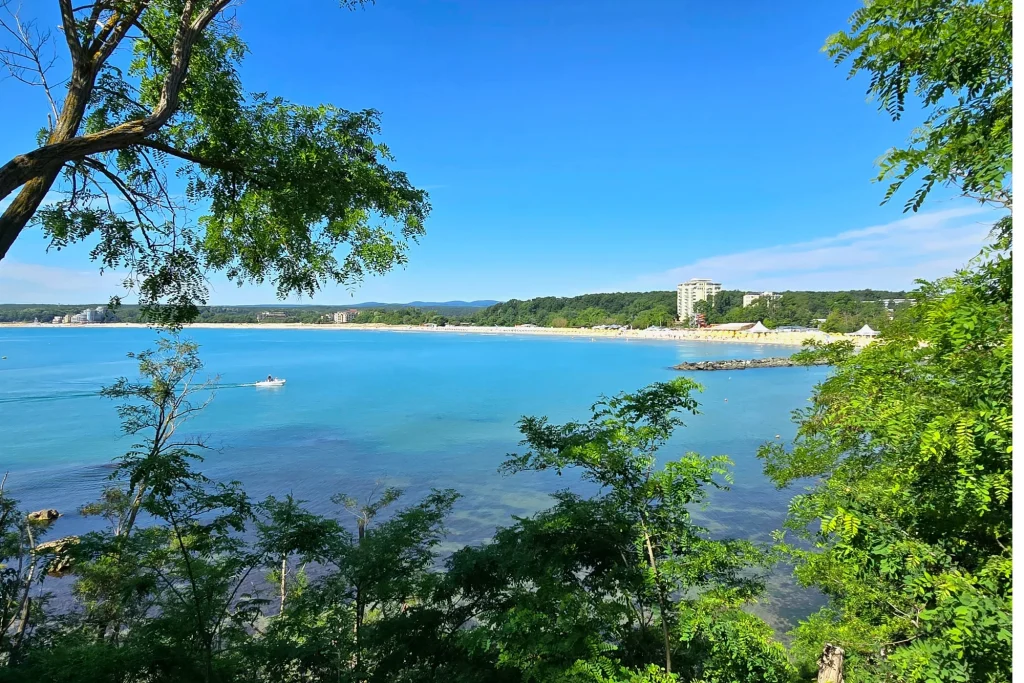
After the middle of September the coast changes within days. The beach empties out, parking stops being a topic, and the heat that makes any walk inland unpleasant is gone. That is when the best season for Strandzha begins — the mountain that starts just south of Primorsko and runs all the way to the border.
Here are three directions, each of which fits into a single day, and what to realistically expect from them out of season.
Why Strandzha is more interesting in autumn
Strandzha Nature Park was declared on 24 January 1995 and is the largest protected territory in Bulgaria. It contains five strict reserves — among them Silkosia, declared in 1933 and the oldest in the country, and Uzunbudzhak, a biosphere reserve since 1977 — along with 21 settlements. This is not an empty forest: people live in it, and some of the villages are museums in their own right.
In summer it is hot and humid here and the forest feels close. In October the temperature drops to the level where walking is a pleasure, the oak and beech change colour, and the marked trails are practically empty.
First direction: Ahtopol and Sinemorets
The easy one. Ahtopol is about 30 km south of Primorsko along the coastal road, and Sinemorets another five kilometres further on.
The interesting part is south of the village. The protected area “Veleka River Mouth” covers around 1,500 hectares and shelters a sand spit of roughly half a kilometre that shifts with the season and the water. This is the only place in Strandzha where the yellow water lily grows, and the area sits on the Via Pontica migration route.
Important for autumn: the protection regime allows organised boat trips up the river between June and September. In October they most likely will not be running. If the boat is the reason you are going, call ahead.
And one more thing: out of season most of the places to eat along this stretch close. Do not count on finding lunch there — check in advance or take something with you. There are no lifeguards on the beaches after the season ends, and the current at the river mouth is deceptive even when the sea looks calm.
Second direction: Brashlyan and Malko Tarnovo
This is a full day, not an afternoon. The road goes through Tsarevo and climbs into the mountain — roughly an hour and a half each way from Primorsko.
Brashlyan is an architectural reserve 14 km north-west of Malko Tarnovo, at about 320 metres above sea level, with a few dozen permanent residents. The 18th-century church of St Dimitar is a cultural monument of national importance and holds an ancient marble votive slab. Beyond it there is a cell school from 1871, an ethnographic house and an agricultural museum full of tools nobody uses any more.
Practical: museums in the small Strandzha villages are often unlocked on request, and opening hours change out of season. Call ahead, or you risk driving up to a locked door. Fill up on the coast — petrol stations inland are few.
Third direction: the sea, which is still working
You do not have to leave the shore to feel the season turn. Bonito passes along the Bulgarian coast towards the end of summer and the beginning of autumn, horse mackerel is active, and as the water cools it is the turn of bluefish. Boats from the Primorsko harbour keep going out as long as the weather allows.
If you plan to fish yourself, recreational fishing in Bulgaria requires a permit, and some species have closed periods and minimum sizes. The rules change — check the current requirements before you cast.
Above all this runs the other migration. The coast is part of Via Pontica, the second largest bird migration route in Europe. Storks start south as early as late August, and September is the peak: flocks pass over the shore that simply are not there the rest of the year. Binoculars are not essential, but they help.
What to bring
- Layers. A morning in the mountain is noticeably cooler than the beach at the same hour.
- Closed shoes. The paths are earth and turn slippery after rain.
- A full tank and an offline map. Mobile coverage in parts of Strandzha is poor.
- Your ID. The strip along the border is a border zone.
- An early start. October gets dark early, and wildlife comes out on the mountain roads in the evening.
- Discipline in the reserves. You enter only on the marked routes.
How to arrange it
With one free day, take the coastal direction: Ahtopol in the morning, the Veleka mouth around midday, back in daylight. With two, the second is for Brashlyan and Malko Tarnovo — leave after breakfast, return towards dinner. Combining the two in one day looks possible on the map and is not.
And if after the mountain you would rather not move at all — the rooms are two hundred metres from the beach, the panoramic pool is on the roof, and Ultra All Inclusive saves you from thinking about dinner after a day on the road. The periods and rates are on the site. And if you head north instead of south, see Beglik Tash, Ropotamo and Perla.